Sep 6, 2026 | JDS Adhesive
Boiling water resistance is a critical indicator of plywood adhesive performance, particularly after extended panel holding. PF systems are highly sensitive to holding time, as moisture loss and pre-curing can create interfacial defects that accelerate water absorption and thickness swelling during boiling-water cycles. In contrast, HPA maintains better reflow and interfacial wetting after prolonged holding, resulting in more stable bond performance and greater process tolerance.
Why Is Boiling Water Resistance Important for Plywood Adhesives?
For plywood used in exterior, marine, and concrete formwork applications, strong water resistance and weather durability are essential to maintaining product performance in demanding environments. Therefore, water-resistance test results are an important indicator when evaluating plywood quality and adhesive performance.
Whether plywood can meet these demanding requirements is closely related to the selection and application of the adhesive. Traditionally, phenol-formaldehyde (PF) resin has been widely used for high-performance plywood because of its proven bonding strength and water resistance.
However, as industry requirements evolve, plywood manufacturers must increasingly balance performance, environmental compliance, process efficiency, raw material costs, total cost, and ESG considerations. As an emerging bio-based adhesive technology, HPA offers advantages across multiple dimensions while aiming to meet the demanding performance traditionally associated with PF. To evaluate this potential, HPA was tested against PF under the same manufacturing conditions across a range of performance indicators. Water absorption and thickness swelling after boiling-water exposure are among the key tests used to compare their performance.
| Key Dimension | PF Resin | HPA Adhesive |
| Performance | Proven high water resistance and bonding performance | Designed to challenge PF-level performance |
| Environmental Compliance | Formaldehyde-based system; emissions require control | Bio-based materials with much lower regulatory compliance pressure |
| Processability | Mature and widely established process | Good process adaptability and tolerance |
| Raw Materials | Primarily fossil-based raw materials | Incorporates renewable biomass-based materials |
| Total Cost | Relatively high and volatile | Relatively stable and neutral |
| ESG | Higher dependence on fossil-based feedstocks | Renewable biomass content supports sustainability goals |
How Are Water Absorption and Thickness Swelling Tested in Plywood?
1. Adhesive Formulation and Panel Manufacturing Conditions
To compare the performance of the two powder adhesive systems based on their different formulations, plywood panels were manufactured under controlled conditions. The adhesive formulations and panel manufacturing conditions were as follows.
Adhesive Mixing Ratios
| Adhesive System | Adhesive Powder | Water | Flour |
| HPA Powder Adhesive | 1 | 1.3 | (Not Required) |
| Phenol-Formaldehyde (PF) Powder Adhesive | 1 | 1.2 | 0.4 |
1.1 Manufacturing Environment
Temperature: 29–35°C
Relative humidity: 45–70%
Date: August 15, 2026
Location: Qiandongnan, Guizhou, China
1.2 Veneer Moisture Content
Eucalyptus veneer moisture content: 11–16% (within the required limit of 20%).
1.3 Glue Application
The adhesives were applied using a roller glue spreader with double-sided application. All other manufacturing parameters followed the respective powder adhesive manufacturer’s processing instructions.
2. Experimental Design for Water Absorption and Thickness Swelling
To better evaluate the effects of different manufacturing conditions on the water absorption and thickness swelling of plywood, four process conditions were designed based on the characteristics of the HPA and PF powder adhesive systems.
The same adhesive application and hot-pressing conditions were maintained, while the holding interval after cold pressing and air-drying time before lay-up were varied.
| Process Parameter | Group 1 | Group 2 | Group 3 | Group 4 |
| Glue Spread (g/m²) | 200 ± 10 | 200 ± 10 | 200 ± 10 | 200 ± 10 |
| Lay-Up Time (min) | 10 | 10 | 10 | 10 |
| Air-Drying Time (h) | 1 | 1 | 1 | 12 |
| Cold-Pressing Time (min) | 150 | 150 | 150 | 150 |
| Holding Interval (h) | 1.5 | 6 | 24 | 1.5 |
| Hot-Pressing Time (min) | 30 | 30 | 30 | 30 |
| Hot-Pressing Temperature (°C) | 130 | 130 | 130 | 130 |
Note: The four process conditions were designed to compare the effects of cold-pressed panel holding time and pre-press air-drying time on the subsequent water absorption and thickness swelling performance of HPA- and PF-bonded plywood.
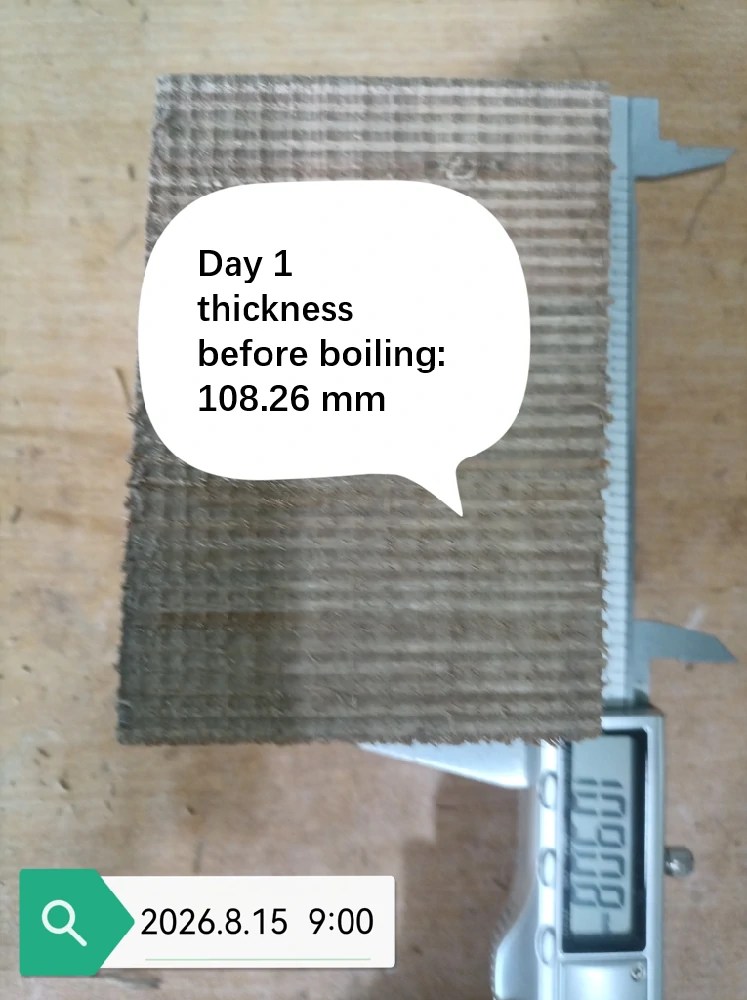
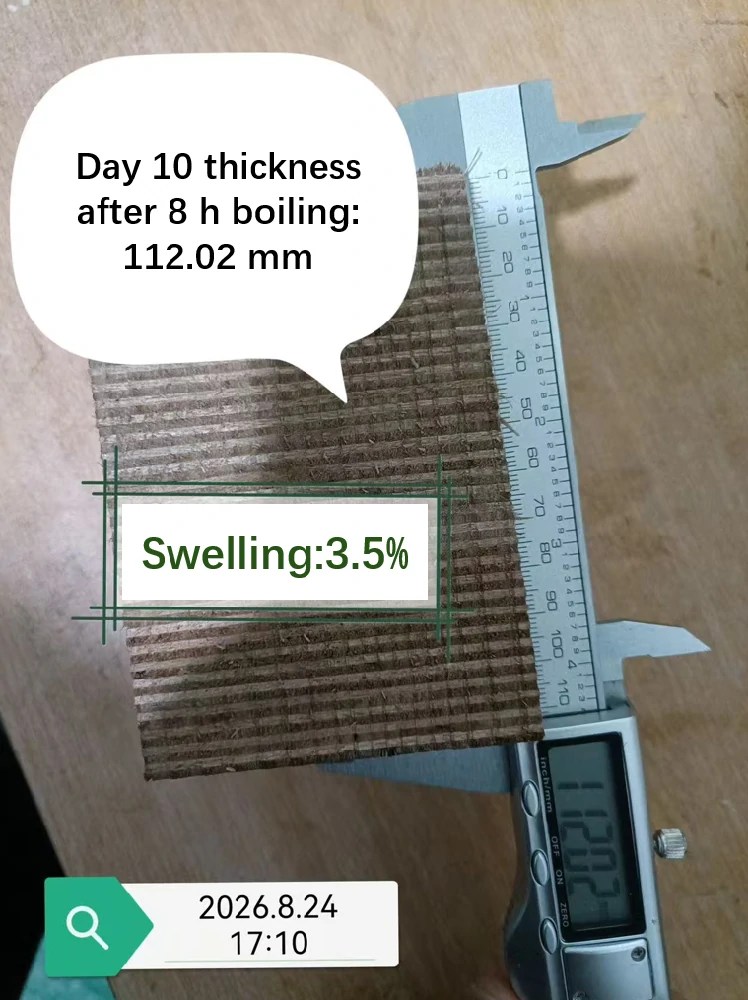
Under the above conditions, plywood specimens were subjected to seven cycles of boiling-water immersion, with each cycle lasting 8 hours. The changes in panel thickness before and after each cycle were measured to calculate the thickness swelling rate and evaluate the water resistance of the plywood.
HPA vs. PF: Boiling Water Resistance Test Results
Group 1: 1.5-Hour Holding After Cold Pressing
The thickness swelling rate increased gradually with the number of boiling-water cycles. HPA powder adhesive showed slightly better performance than conventional PF powder adhesive.
Group 2: 6-Hour Holding After Cold Pressing
The thickness swelling rate increased gradually with the number of boiling-water cycles. Starting from the fifth cycle, HPA powder adhesive showed clearly better performance than conventional PF powder adhesive.
Group 3: 24-Hour Holding After Cold Pressing
The thickness swelling rate increased with the number of boiling-water cycles. Starting from the second cycle, HPA powder adhesive showed clearly better performance than conventional PF powder adhesive.
Group 4: 12-Hour Holding After Glue Application
The thickness swelling rate increased with the number of boiling-water cycles. HPA powder adhesive significantly outperformed conventional PF powder adhesive and maintained a relatively low thickness swelling rate even under these severe conditions.
Based on the test results above, conventional PF powder adhesive has limited adaptability under the following conditions:
- Extended storage after cold pressing: The process window is difficult to expand, as prolonged holding can negatively affect subsequent bonding performance.
- xtended storage after glue application: The production operating window becomes narrower, which is unfavorable for panel lay-up and handling/transport processes.
Why Does HPA Provide Better Water Resistance Than PF?
The PF powder adhesive system shows a clear time-threshold effect with respect to the holding time of cold-pressed panels. Under stacked conditions after cold pressing, the adhesive layers at the panel edges are exposed to air and therefore lose moisture more rapidly, while the glue lines in the panel core are relatively enclosed, making moisture evaporation and localized resin pre-curing a slower process. After 6 hours of holding, some degree of pre-curing occurs only at the panel edges, while the core PF resin still retains sufficient hot-press melt flow and interfacial wetting capability. Therefore, the initial increase in thickness swelling is limited, and interfacial defects become progressively apparent only after multiple boiling-water cycles. When the holding time is extended to 24 hours, substantial moisture loss occurs in the core glue lines, resulting in irreversible localized pre-crosslinking of the PF resin. Microscopic defects at the wood–adhesive interface are therefore formed during hot pressing, causing thickness swelling to increase from the first boiling-water cycle. These defects then expand rapidly during subsequent cycles, resulting in a sharp increase in thickness swelling.
Even after 24 hours of panel holding, the HPA powder adhesive system is less prone to deep, irreversible pre-curing, allowing good interfacial wetting to be maintained during hot pressing. Its performance degradation is mainly caused by interfacial hydrolysis during repeated boiling-water cycles, representing cumulative damage at a later stage. Therefore, HPA is much less sensitive to panel holding time than PF.
Table 4: The 12-hour air-drying period between glue application and cold pressing has a substantially greater negative impact on PF than 24 hours of stacked holding after cold pressing. Under open-air conditions, PF readily forms a surface skin and undergoes pre-curing, resulting in inherent bonding defects. In comparison, HPA is less affected by panel air-drying time and offers better process tolerance.
Related Products
Explore HPA Bio-Based Adhesive: An Advanced High-Strength Adhesive for Exterior- and Marine-Grade Plywood and Concrete Formwork Plywood
→ Learn more about HPA WBP solutions
HPA Eco-Friendly Adhesive for Plywood
A low-emission HPA solution for plywood and engineered panels, helping manufacturers meet stricter environmental standards with formaldehyde-free technology and reliable bonding performance.